Showing posts with label Fitness. Show all posts

The Best 5 Exercises To Tone Your Legs

If you think that hundreds of squats and lunges are going to result in slim, toned legs, you're in for an unpleasant surprise. Reducing fat from your legs requires that you take an approach that focuses on your entire body. 

When your body fat reduces, so will that jiggling, excess fat that's covering your leg muscles. For optimal results, makeover your diet, exercise routine and lifestyle. If you are looking for a diet that really works here is one that even CNN recommends it - Fat Diminisher System By Wes Virgin.

If there’s one part of the human body that can be too skinny, too thick, too soft, too weak or too baggy, it would be the thighs. Whether you want to trim your outer or inner thighs to look better in your clothes (or out of them), or you want a bit of extra strength in your quads and hamstrings, this article is for you.

1.Warrior III

Stand with the feet together, and lift up the left leg with a pointed toe, putting your body weight onto the standing, right leg. Continue to lift your leg and drop the head and torso so they form a straight horizontal line from head to toe with the arms at your sides. 

Engage your core and make sure the left thigh, hip, and toes are aligned. Remain facing down and keep your back as straight as possible. Ensure your right knee doesn't lock and center the weight on the middle of the foot. Hold for 5 breaths and then slowly return to standing.

Switch legs and repeat.

2.Chair Squat

This is a perfect move for beginners, and we're betting you're sitting on the only equipment you need as you read this. Hint: If you have a chair (and your glutes), you're good to go.

Begin standing with your back to a chair, feet hip-width apart. While keeping your weight centered on your heels, draw in your abs and hinge forward at the hips slowly lowering your butt toward the chair. Pause right before you would sit down and return to standing while keeping the core engaged.

Do 3 sets of 10-15 reps.

3.Low Lunge Hover

This standing move works both the legs and butt.

Stand with feet hip-width apart before stepping your right foot back, and lowering into lunge stance with the left knee over the ankle. Bring your arms over your head and hinge forward from the waist. Lower the chest forward toward the thighs as your arms reach forward. Lift the right leg while straightening the left. Hold for 3 breaths before returning to the starting lunge position.

Do 3 reps; switch legs and repeat.

4.Leg Lift

This move targets the quads.

While you stand facing a chair, raise your right leg, knee facing up, foot flexed and place your heel on the seat. Make sure not to lock your standing knee as you lift your right foot off the chair and straighten it out until you feel your quadriceps engage. Keeping your lifted leg in the air, bend the leg on the floor slightly and then straighten it again.

Do 10-15 reps, then switch sides and repeat for 1 full set; do 3 sets.

5.V-Position


This V-Position is similar to a ballet plié and just like that classic move, it works the thighs, hips, and glutes.

Stand holding the back of a chair with one hand. Place your feet in a V position, toes should be about 4 inches apart and heels stay pressed together. Bend your knees and lift the heels a few inches off the floor. Then, lower your hips until you feel your quads intensely working. Pulse up and down.

10-15 pulses up and down completes 1 set; do 3 sets.

Top 30 Biggest Myths About Weight Loss

Misconceptions about how to lose weight abound, especially on the Internet. Get the facts on shedding pounds now: Start by dispelling these 30 commonly held — but wholly inaccurate — notions.
Myth 1: Some foods speed up your metabolism.

Metabolism describes all the chemical processes that go on continuously inside the body to keep you alive and your organs functioning normally, such as breathing, repairing cells and digesting food. 

These processes need energy and the amount of energy required varies between individuals depending on factors such as body size, age, gender and genes.

It is claimed that certain foods and drinks can increase your metabolism by helping the body to burn more calories and aid weight loss. 

There is little scientific evidence for this. Beware that some of these products may contain high levels of caffeine and sugar. To lose weight you need to burn more calories than you consume.

Myth 2:  All slimming pills are safe to use for weight loss.

Myth 3: Fad diets will help me lose weight and keep it off.

Myth 4: Grain products such as bread, pasta, and rice are fattening. I should avoid them when trying to lose weight.

Myth 5: Some people can eat whatever they want and still lose weight.

Myth 6: "Low-fat" or "fat-free" means no calories.

Myth 7: Set a Realistic Goal Weight—Or Else You'll Be Totally Discouraged.

It sounds reasonable, but there's no evidence to back it up: Feeling frustrated about a seemingly difficult-to-achieve weight isn't going to preclude you from hitting your goal.

Myth 8: Fast foods are always an unhealthy choice. You should not eat them when dieting.

TIP: Many fast foods are unhealthy and may affect weight gain. However, if you do eat fast food, choose menu options with care. Both at home and away, choose healthy foods that are nutrient rich, low in calories, and small in portion size.

To choose healthy, low-calorie options, check the nutrition facts. These are often offered on the menu or on restaurant websites. And know that the nutrition facts often do not include sauces and extras. Try these tips:
  • Avoid "value" combo meals, which tend to have more calories than you need in one meal.
  • Choose fresh fruit items or nonfat yogurt for dessert.
  • Limit your use of toppings that are high in fat and calories, such as bacon, cheese, regular mayonnaise, salad dressings, and tartar sauce.
  • Pick steamed or baked items over fried ones.
  • Sip on water or fat-free milk instead of soda.
Myth 9: If I skip meals, I can lose weight.

Myth 10: Eating healthy food costs too much.

Myth 11: Lifting weights is not a good way to lose weight because it will make me "bulk up."

Myth 12: Physical activity only counts if I can do it for long periods of time.

Myth 13: Don't Lose Weight Quickly—Go Slowly

You've heard it a million times: If you lose weight super quickly, it'll be hard to keep that weight off in the long-run, compared to losing weight slowly and steadily. 

Turns out there's not much research to support this, and that weight-loss retention is a lot more complicated than the speed at which you drop the pounds at the outset.

Myth 14: Eating meat is bad for my health and makes it harder to lose weight.

Myth 15: Dairy products are fattening and unhealthy.

Myth 16: "Going vegetarian" will help me lose weight and be healthier.

Myth 17: Weighing Yourself Daily Interferes with Weight Loss

Myth 18: Genes Aren't a Factor in the Obesity Epidemic.

While you'd love to inherit your mom's smarts, smile, and sense of style, her slow metabolism and tendency to crash diet are traits you'd probably rather pass on
.

Myth 19: A radical exercise regime is the only way to lose weight.

Myth 20: Starving myself is the best way to lose weight.

Myth 21: Cutting out all snacks can help you lose weight.

Snacking isn't the problem when trying to lose weight: it's the type of snack. 

Many people need a snack in-between meals to maintain energy levels, especially if they have an active lifestyle. Choose fruit or vegetables instead of crisps, chocolate and other snacks that are high in sugar, salt and  fat.

Myth 22: Drinking water helps you lose weight.

Water does not cause you to lose weight, but it does keep you hydrated and might help you snack less. Water is essential for good health and well being. 

Sometimes thirst can be mistaken for hunger – if you're thirsty you may snack more.

Myth 23: There are some magical foods that cause weight loss.

Myth 24: Drinking while you are eating is fattening.

Myth 25: Losing Weight is a Linear Process.

Losing weight is usually not a linear process, like some people think.
Some days and weeks you may lose, while during others you may gain a little bit.

Losing weight can take a long time. The process is generally not completely linear, as weight tends to fluctuate up and down by a few pounds.

Myth 26: “Eat Less, Move More” is Good Advice.

Myth 27: Fat Makes You Fat.

Body fat is stored fat. So, eating more fat should make us store more of it. It seems logical.

However, it turns out that things aren’t this simple. There is nothing uniquely fattening about fat, except that it is often found in calorie-dense junk foods.

As long as calories are within range, fat does not make you fat. Additionally, diets that are high in fat (but low in carbs) have been shown to cause weight loss in numerous studies.

As with so many things in nutrition, this depends entirely on the context.

Eating a lot of fat along with a high-carb, high-calorie, junk food-based diet will definitely make you fat. But it’s not just because of the fat.

Fat has often been blamed for the obesity epidemic, but there is nothing inherently fattening about dietary fat. It depends entirely on the context.

Myth 28: Eating Breakfast is Necessary to Lose Weight.

Myth 29: People With Obesity Are Unhealthy, Thin People are Healthy.

It is true that obesity is associated with an increased risk of several chronic diseases.

This includes type 2 diabetes, heart disease, increased risk of some cancers, and others.

However, there are still plenty of people with obesity who are metabolically healthy, and plenty of thin people who have these same chronic diseases.

It seems to matter where the fat builds up. If you have a lot of fat in the abdominal area, around the organs, then this type of fat is much more strongly associated with metabolic disease.

The fat that builds up under the skin, the subcutaneous fat, is more of a cosmetic problem.

Obesity is linked to several chronic diseases, such as type 2 diabetes. However, many people with obesity are metabolically healthy, and many thin people are not.


Myth 30: Frozen fruits and vegetables are less nutritious than fresh ones.

The Best Calf-Toning Workout

The best calf workout to tone your legs are exercises that can be performed just about anywhere and are easy to do, especially if you have a busy lifestyle.

Heel Raise 4 Sets - 15 Reps

The heel raise is a powerful way of toning your calf muscle by concentrating your body weight on one leg. 

Balance yourself by standing on your right foot with your left foot behind your right calf. 

Slowly raise up on the ball of your right foot, contracting your calf at the top of the lift. Relax and lower to the starting position.

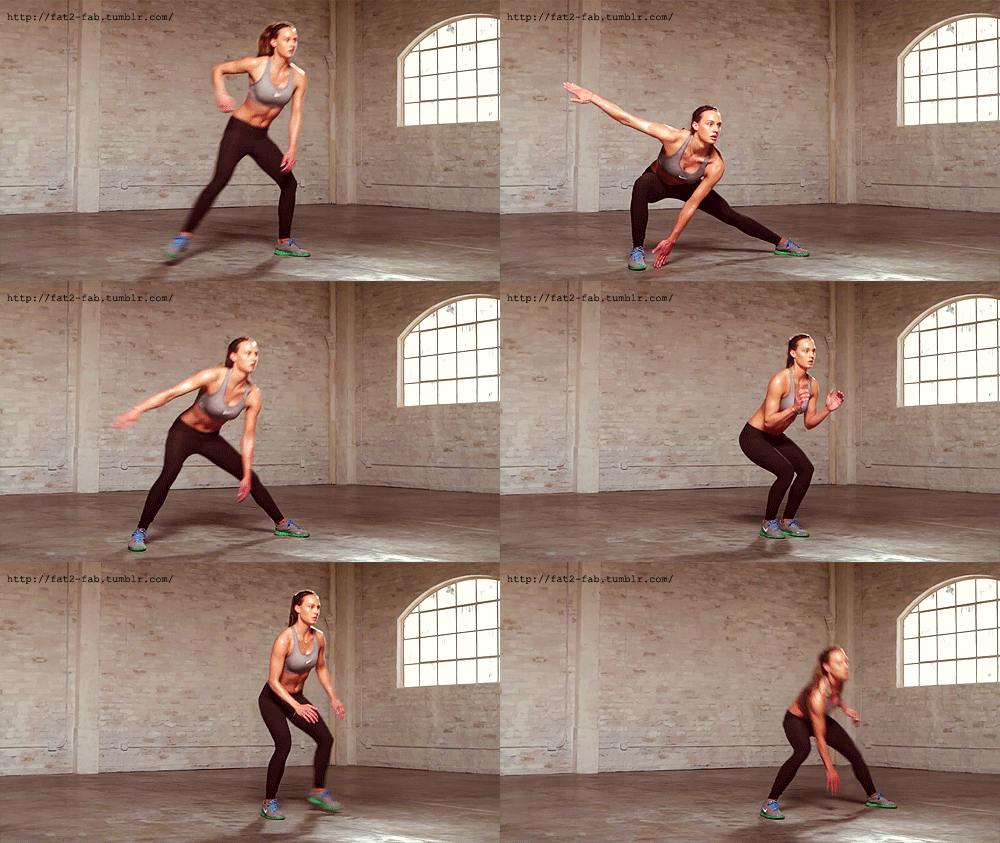
Side Lunges 3 Sets - 10 Reps

Performing side lunges will tone and strengthen your calf muscles to maintain balance. 

While standing up straight with legs shoulder-width apart, turn your torso to the right, Turn your right foot to point in the same direction. 

Slowly lunge halfway down, bending at the knee feeling the stretch in your calf. Slowly raise back up to starting position. 

Calf Lift 3 Sets - 15 Reps

The calf lift is an exercise that tones your calf muscles and defines the muscle. 

Standing with your hands on your hips or resting them on an object in front of you. 

Raise up on your toes, feeling the stretch in your calf muscles. Hold this position for three seconds and lower.

Calf Raise on Step 3 Sets - 10 Reps


Step calf raises tone and define your calf muscles. Stand on a step or on a couple of books, with your heel freely hanging over the edge. 

Hold onto an object in front of you, such as a chair, for balance. Raise up on the balls of your feet, hold for two seconds and lower your heels down, lower than the level of the step. 

When you have mastered this exercise, performing this exercise one leg at time will give you a more intense workout.

Tips
Perform exercises for your calf muscles every second day. Leave a day in between for rest and recovery.


3 SIMPLE WAYS TO GET RID OF NECK FAT

The excess weight around your face and neck may be due to an accumulation of fatty deposits around the chin area and neck. Causes may include general obesity, water retention or aging. 

A cosmetic surgeon can remove facial fat by performing liposuction, but many people cannot afford—or would prefer not—to "go under the knife." Less intrusive methods are available to help reduce fatty deposits in the neck and face.

Excess fat around the neck is not only unsightly but also can be an early sign of obesity. Because of its proximity to the face, fat in the neck area can lead to problems with self-esteem. 

There's no way to target the neck, or any other area of the body, to remove fat specifically from that area.

But you can exercise the neck area to stimulate muscle growth that will help burn the surrounding fat more efficiently than before.

Neck Stretch

Lift your head from your chest and stretch your head back as far as possible, stretching your neck out. Stretch your head back looking at the ceiling and go as far back as you comfortably can.

Keep your mouth slightly opened while you do this so you feel the muscles in your neck stretch and tighten.  These are the platysma muscles of your neck and chin.

Hold this position for ten seconds and then bring your head back into its regular position.

Repeat this exercise several times a day until you’re able to do it at least 10 times daily.

Lip Pull

Stand with good posture with your head in its natural position. Push your jaw out and lift your lower lip as high on your face as possible. 

Hold it in that position for 10 seconds, then relax. You should feel the muscles directly underneath your chin stretch a bit.

And you will REALLY feel this in your jaw and jawline! Do this 10 times every day.

Chin Pull

To do the chin pull, start off with your body and head in its normal position.

Then, raise your chin and pull it upwards as far as it can go. You should feel the facial muscles pulling in your throat and chin. Hold your chin in this stretched position for 10 seconds and then relax.

Repeat this exercise 10 times, as usual.

7 Amazingly Effective Arm Slimming Exercises for Women

Let’s face it, amazing arms effortlessly pair well with anything in your closet!

These routines showcase some of the BEST moves to target your full upper body including triceps, biceps and shoulders.

The muscles of the upper arm are dominated by the two-headed biceps and the three-headed triceps that lie at the back of the arms.

The biceps receive the most attention in the exercise community because of male fascination with ‘bigger guns’, but the muscles that can make the most difference to the shape of the upper arms is the triceps. Located at the back of the arms, the triceps actually forms the bulk of the upper arms.

Taking care of your triceps is therefore one of best things you can do to improve arm shape and tone.

A weak triceps contribute to saggy arms.This is often made worse by excess arm flab – unfortunately, especially after significant weight loss. Talk about frustration! You manage to lose weight, and then you have saggy skin on your arms?

The good news is that you can train your arms to be thinner yet stronger and look more shapely.

THE WORKOUT

You can use books as weights in case you don't hit the gym and prefer to workout at home.

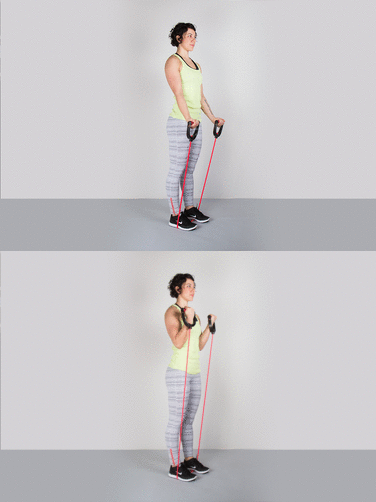
1.BICEP CURLS 4 SETS/ 10-15 REPS

2.MODIFIED PUSH-UPS 3 SETS/10 REPS

3.TRICEPS DIPS 4 SETS/10-15 REPS

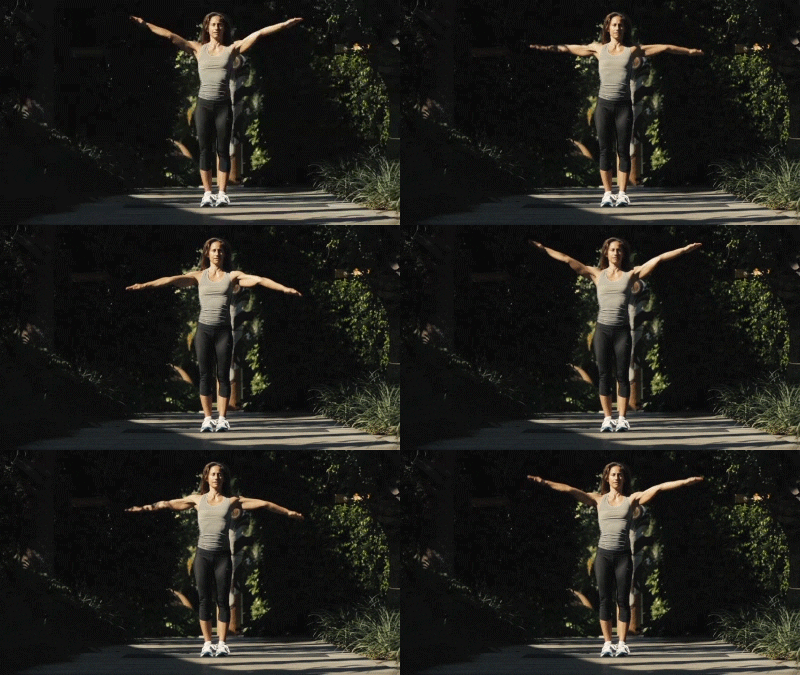
4.ARM CIRCLES 3 SETS/15 ROTATIONS 

5.OVERHEAD BEND 4 SETS/15 REPS


6.STRAIGHT ARM SHRUG 2 SETS/15 REPS

7.THE PILATES PRESS 3 SETS/10-15 REPS


THE BEST KEPT SECRET ABOUT LOSING WEIGHT

So you want to lose weight?  It’s a commendable goal and the benefits are plenty (self-esteem, energy, quality of life, preventing disease, longevity, and lower health costs). 

With an epidemic of obesity, people are looking for ways to obtain or maintain a healthy weight, yet their goals are being hijacked. Many of the saboteurs are controllable and easy, yet they are ambiguous. 

So instead of focusing on how to lose weight, try instead on the causes that may be preventing you from losing weight.
Here are 7 reasons you may be struggling with weight loss

1.You’re Not Cutting Back on Carbohydrates Enough

Some people are more carb sensitive than others.If you’re eating low-carb and your weight starts to plateau, then you may want to cut back on carbs even further.

In that case, go under 50 grams of carbs per day. When you go under 50 grams per day then you’re going to have to eliminate most fruits from your diet, although you can have berries in small amounts.

If that doesn’t work either, going under 20 grams temporarily can work… eating just protein, healthy fats and leafy green vegetables.

2.You’re Not Eating Real Food

A low-carb diet is about more than just lowering your intake of carbs.

You have to replace those carbohydrates with real, nutritious foods.
Throw away all processed low-carb products like Atkins bars, they are not real food and they are NOT good for your health.

Stick to meats, fish, eggs, vegetables and healthy fats if you need to lose weight.

Also, “treats” like paleo cookies and brownies can cause problems even though they’re made with healthy ingredients. They should be considered as occasional treats, not something you eat every day.

What is also important is to eat enough FAT. If you try to cut back on carbs AND fat, you will end up ravenously hungry and feel like crap..

3.You Skimp on Protein

Several studies show that high-protein diets result in more pounds shed, at least initially. Protein enhances the feeling of satiety and prevents your losing muscle as you lose fat. 

You also have dietary thermogenesis, which is the energy you burn to process and use the food you eat, on your side. 

"Your body expends more energy to metabolize protein than carbs or fat," says Cari Coulter, RD, the program director for Wellspring Weight Loss Camp in Kenosha, Wisconsin. "So higher-protein diets make you burn slightly more calories."

So how much protein do I need a day? "It depends on your weight, but most women should get 40 to 80 grams," Dr. Smith says. 

To accomplish that, You can have Greek yogurt (18 grams) or a couple of eggs (13 grams) for breakfast, and I eat a few ounces of lean poultry (25 grams) or fish (22 grams) or a heaping helping of black beans (15 grams) or lentils (18 grams) at lunch and dinner.

Snack on a handful of raw almonds (6 grams). As a result, you feel fuller — sometimes so full you don't even have to sneak a bite of your son's ice cream — so it's easier to keep daily calories in check.

4.You Don’t Have Realistic Expectations

At the end of the day, weight loss takes time.It is a marathon, not a race.

Losing 1-2 pounds per week is a realistic goal. Some people will lose weight faster than that, others slower.

But it’s also important to keep in mind that not everyone can look like a fitness model.

At some point, you will reach a healthy set point weight, which may be above what you initially hoped for.

5.You’ve Been “Cutting” For Too Long

It’s a good idea to be in a calorie deficit for too long at a time.
The leanest people on earth (bodybuilders and fitness models) never do this. They do cycles of “bulking” and “cutting.”

If you eat at a calorie deficit for many months (or years) then eventually your metabolic rate may slow down.

If you’ve been dieting for a long time, then a two month period where you aim to “maintain” and gain a bit of muscle may be what you need to get things started again.

Of course, this doesn’t mean eating bad foods, just more of the good stuff.

After these two months are over, you can start “dieting” again.

6.You Work Out Regularly

For starters, people tend to eat more when they work out, either because they feel they've earned it or because they're overestimating how much they've burned — or both. 

This is especially true in the early stages of a fitness program, when your body is getting used to the decrease in calories consumed and the increase in calories burned.

But here's the real shocker: Working out can make you retain water. To ensure that you don't get dehydrated, the plasma in your bloodstream will store an extra two to four pounds of water . 

You'll always carry that extra water unless you become inactive; it's not fat or muscle, but simply superhydration. 

It's also a good thing to keep chugging H2O, which can, counterintuitively, help minimize additional water retention.

7.You're a Stress Case

The stress hormone cortisol triggers the fight-or-flight response, which is an appetite stimulant. 

In addition, it steps up the production of a certain brain chemical, neuropeptide Y, which increases cravings for carbohydrates.

Too much cortisol slows metabolism. Even worse, excessive stress causes fat to be stored in the abdominal area, where weight is harder to lose.

Balanced, nutritious meals can repair the damage that stress does to the body.